Food handler training in South Africa: the complete guide
What food handler training actually requires under R638, the real options available, and how to choose between accredited courses, compliance software, and engagement tools.
Food handler training is instruction (required by law for every food handler in South Africa under Regulation R638) that covers hygiene, cross-contamination, temperature control, and safe handling practices. The designated Person in Charge must hold accredited training specifically. It's not one course or one format: most food businesses use a mix of accredited training, documentation tools, and ongoing reinforcement to keep it current. This guide covers what's actually required, the real options available, and how to choose between them.
What is food handler training?
Food handler training gives anyone who handles food for sale (production staff, packers, kitchen staff, cashiers who handle unpackaged food) the practical knowledge to prevent contamination and foodborne illness. It typically covers personal hygiene, cross-contamination risks, temperature control, allergen awareness, and what to do when something goes wrong (a spill, an illness, a pest sighting). It's distinct from a qualification or degree: it's operational, practical knowledge tied to a specific workplace and its hazards.
Is food handler training a legal requirement in South Africa?
Yes. Under Regulation R638 of 2018 (Regulations Governing General Hygiene Requirements for Food Premises, the Transport of Food and Related Matters), every food handler needs appropriate instruction and training, with evidence of competency an environmental health inspector can review. The designated Person in Charge specifically must complete accredited food safety training. R638 applies broadly: restaurants, retailers, manufacturers, cold stores, and food-carrying vehicles are all covered as "food premises". For the full detail on how this plays out in practice, see our food safety training page, which covers R638 in more depth, and our glossary of food safety terms for plain-English definitions.
Who needs food handler training?
Anyone who handles food intended for sale to the public: production and packing staff, kitchen and front-of-house staff who handle unpackaged food, cleaners working in food-contact areas, and supervisors and managers responsible for oversight. New starters need induction-level training before they're handling food unsupervised; everyone needs periodic refreshers.
Your options for food handler training in South Africa
There isn't one right answer. Most businesses combine more than one of these:
| Option | What it does | What it doesn't do | Typical use |
|---|---|---|---|
| Accredited SETA / R638 courses: in person or e-learning, from providers like ASC Food Safety, Entecom or NSF South Africa | Issues the accredited training and certification required for your Person in Charge and formal handler records | Doesn't guarantee retention; a once-off course fades without reinforcement | The legal baseline every food business needs |
| Digital compliance & checklist software: such as GoAudits, food-safety.app, or Entecom's compliance software | Stores training records, audit trails, and HACCP documentation | Doesn't teach or reinforce anything; it's a record-keeping layer, not a training layer | Audit-readiness and paperwork, alongside actual training |
| Printed materials & posters | Cheap, always visible, good for quick reference | Passive; nothing measures whether anyone reads or retains it | Supplementary reminders, not primary training |
| Training games & engagement tools: such as Food Safety Legends | Reinforces what accredited training already covered, through real production scenarios, in a format teams actually engage with | Doesn't issue certificates and isn't a substitute for accredited training | Refreshers, inductions, toolbox talks, and pre-audit knowledge checks, between formal training cycles |
How to choose the right mix
Start with the legal baseline: an accredited course for your Person in Charge and documented training for every handler. Layer in a compliance tool if you're managing records across more than a handful of staff or multiple sites. Then look honestly at retention. If refresher sessions feel like a formality nobody's engaged with, that's the gap an engagement tool is built to close, not instead of the accredited course, but so the knowledge from it actually survives past week one. Our guides on informal food safety assessments and training food handlers as your team grows go deeper on each. Booking the accredited course itself? See food safety courses and certificates in South Africa, or, if your business needs it specifically, what HACCP training covers. For the refresher side of the regulation, see our guide to R638 training, and for the role R638 singles out, our guide to Person in Charge training.
Where Food Safety Legends fits
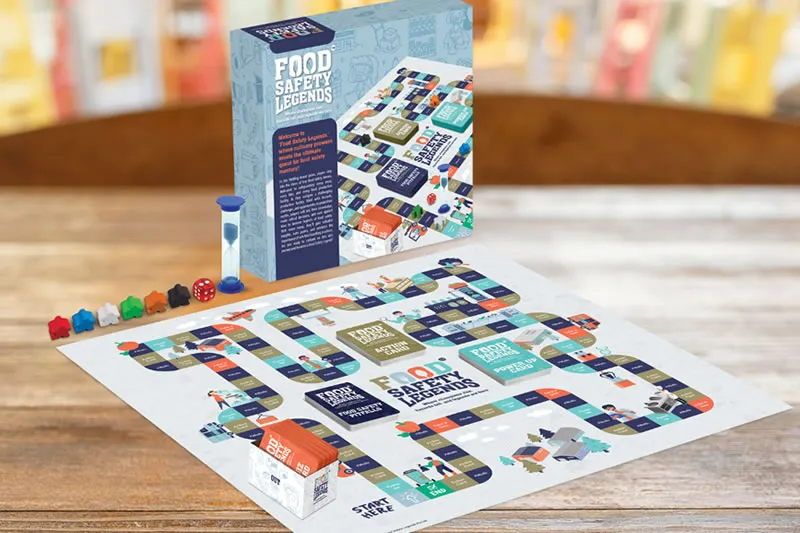
Food Safety Legends is a board game built around real production scenarios, designed to reinforce food handler training rather than replace it. It's used by South African food businesses for refreshers, inductions, toolbox talks, and pre-audit knowledge checks. It's built to work in any food production space, from a production floor to a retail kitchen to a distribution centre, not just one narrow segment. It doesn't issue certificates and isn't accredited training in itself; it's the layer that keeps accredited training from fading between formal refresher cycles. See our food safety games and games for employees pages for the formats it supports.
See how it's played · read about food safety culture · order the game.
Common questions
What is food handler training?
Instruction covering hygiene, cross-contamination, temperature control, and safe handling practices for anyone who handles food for sale. It's practical and workplace-specific, not a general qualification.
Is food handler training a legal requirement in South Africa?
Yes, Regulation R638 of 2018 requires appropriate instruction and evidence of competency for every food handler, and accredited training specifically for the designated Person in Charge.
How often should food handlers be retrained?
R638 doesn't set a fixed interval; it requires ongoing, demonstrable competency. Most businesses run periodic refreshers (commonly annual or more frequent) alongside induction training for new starters and targeted retraining after any incident or audit finding.
Does a training game count as food handler training?
No, a game like Food Safety Legends isn't accredited training and doesn't issue certificates. It reinforces the accredited training your Person in Charge and handlers have already completed, but it doesn't satisfy the R638 accredited-training requirement on its own.
What is R638 training?
R638 training is shorthand for the food safety and hygiene training Regulation R638 requires: appropriate instruction with evidence of competency for every food handler, and accredited training specifically for the designated Person in Charge. R638 itself doesn’t prescribe a fixed syllabus or provider, it sets the requirement; food safety courses and food handler courses are how businesses meet it.
Sources: Regulation R638 of 2018 (Foodstuffs, Cosmetics and Disinfectants Act 54 of 1972).
Keep food handler training from fading
Order Food Safety Legends to reinforce your accredited training between refresher cycles.