Culture Room Article
Informal Food Safety Assessments: How to Self-Check Before the Real Audit
An informal food safety assessment is an internal, self-run check of your food safety practices, done by your own team rather than an external auditor, to catch gaps before a formal audit or municipal inspection finds them. It’s not a substitute for a formal audit and it doesn’t carry legal or certification weight, but it’s one of the cheapest, most effective ways to know where you actually stand before someone else tells you.
What is an informal food safety assessment?
It’s a self-check, walking your own premises, records, and team knowledge with the same critical eye an auditor would use, but internally, informally, and as often as you like. No inspector, no report, no consequences beyond what you decide to do with what you find.
How is it different from a formal audit?
A formal audit (a municipal Certificate of Acceptability inspection, or a third-party FSSC 22000 / BRCGS audit) is external, documented, and consequential, it can affect your ability to trade or your certification status. An informal assessment is internal and low-stakes by design. That’s exactly what makes it useful: your team can be honest about what’s not working without the pressure of an official finding on record.
Six areas to check
- Documentation & records, are cleaning schedules, temperature logs, and training records actually up to date, not just started and abandoned?
- Hygiene practices, handwashing, protective clothing, and separation of raw/ready-to-eat food, observed in practice, not just described in your policy.
- Temperature control practices, are staff actually following your temperature control procedures during a real shift, not just when someone’s watching?
- Pest & waste management, signs of pest activity, waste handling and storage, cleanliness of bins and disposal areas.
- Corrective-action habits, when something goes wrong (a spill, a near-miss, a batch that looks off), does someone actually act on it and record it, or does it quietly get ignored?
- Staff knowledge, not just “have they been trained, ” but do they actually know what to do in a real scenario, under pressure, without someone telling them the textbook answer?
The part most informal checks miss: staff knowledge
Most DIY checklists are built around the first five areas, they’re observable, checkable, and easy to tick off a list. Staff knowledge is harder to assess informally, because asking someone “do you know the hygiene rules?” gets you a yes whether or not it’s true. The gap only shows up when someone actually has to make a call under realistic conditions, which batch to reject, which surface needs sanitising before the next task, how to handle an allergen mix-up.
A simple way to run a team-wide knowledge check
Rather than a written quiz (which tests memorisation, not judgement), run your team through real scenarios and see how they actually respond. A structured session, everyone working through the same set of realistic production-floor decisions together, surfaces knowledge gaps far faster than asking people to self-report their own confidence, and it does it without singling anyone out, since the whole team plays together.
Using a game as an informal knowledge check
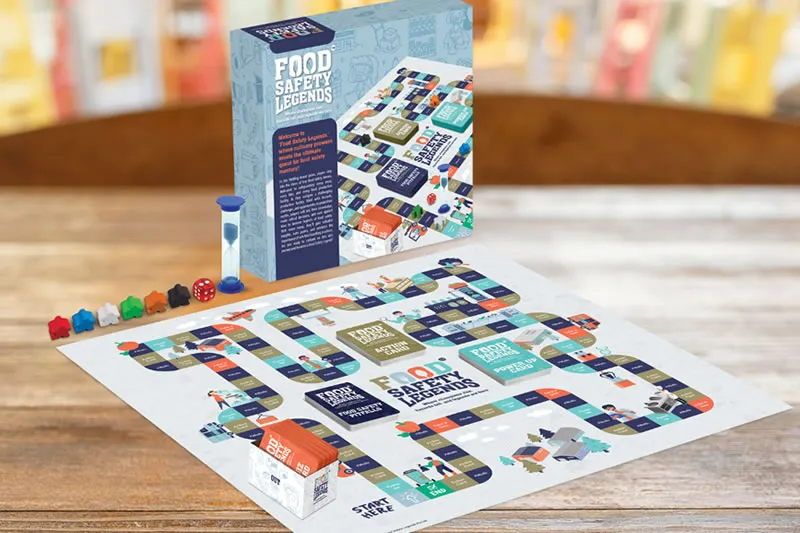
A formal test can feel intimidating, and people often freeze or guess. A game gives managers the same insight in a relaxed setting. As teams play Food Safety Legends, watch how they discuss each Pitfall scenario, which corrective actions they reach for, and which quiz rounds they struggle with. That real-time view often shows strengths and weaknesses more clearly than a written test, so you can target refresher training, reinforce specific procedures, or improve communication where it matters.
Where Food Safety Legends fits
Food Safety Legends is built around exactly this kind of scenario-based knowledge check. Teams work through real production decisions (the same kind of judgement calls covered above) which makes it a practical way to run the “staff knowledge” part of an informal assessment specifically, ahead of a real audit. It’s suitable for any food production space, and it’s a reinforcement tool, not a substitute for your formal training or your formal audit process.
See how it’s played · read the food handler training guide · order the game.
Related: signs of a weak food safety culture · building a food safety culture · ways to play with your team.
Sources: Regulation R638 of 2018 (Foodstuffs, Cosmetics and Disinfectants Act 54 of 1972).
Common questions
What is an informal food safety assessment?
An internal self-check of your food safety practices, run by your own team rather than an external auditor, used to find gaps before a formal audit does.
Is an informal assessment the same as a mock audit?
Close, a mock audit usually simulates the formal audit process itself, while an informal assessment can be looser and more frequent. Both serve the same purpose: finding problems before someone else does.
How often should we run an informal assessment?
There's no fixed rule, many businesses run a light version monthly and a fuller one ahead of any scheduled formal audit or inspection.
Can a food safety game replace a formal self-assessment?
No, it's a useful way to check staff knowledge specifically, one of several areas worth checking. It doesn't cover documentation, infrastructure, or the other areas a full informal assessment should include.